
The Quiet Place Franchise and the Argument for Sound as Storytelling
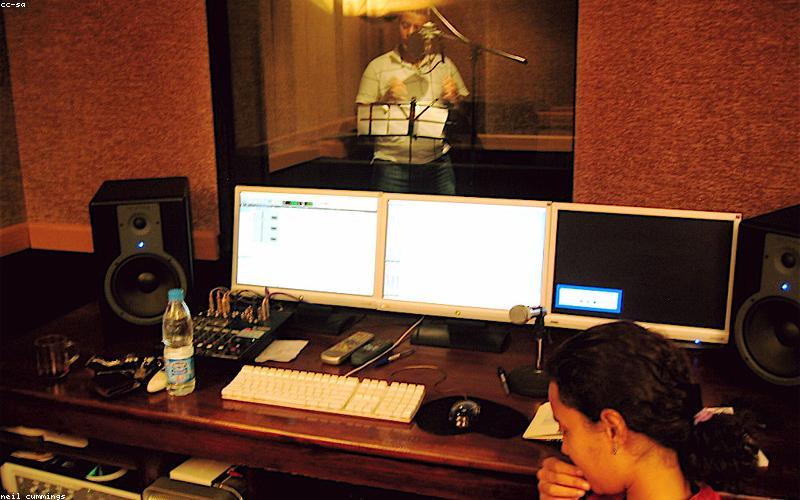
## A Premise That Looked Like a Gimmick
When A Quiet Place was first pitched in 2017, the elevator-pitch version sounded like a one-trick premise. Aliens hunt by sound. A family must remain silent. The film would be largely without dialogue. It's the kind of high-concept idea that horror screenplays often produce, where the gimmick is the entire selling point and the execution often disappoints.
What John Krasinski and his collaborators discovered, almost as an accident, was that the premise had unusual structural depth. Silence is not the same as silence. There's the silence of cautious whispering. The silence of holding your breath. The silence of suppressed grief. The silence of two people refusing to speak about something they both know. The silence of a child whose hearing aids have just died. Each of these silences has a different sonic texture, and a film willing to take its silence seriously could mine all of them for storytelling.
The original 2018 film grossed $341 million worldwide on a $17 million budget. The sequel in 2021 made $297 million during a pandemic-disrupted release window. The spinoff Day One, released in 2024, made $261 million. The franchise is now five films deep including the upcoming sequels in the main timeline, and it has consistently been one of the most profitable horror brands of its era. The interesting question is how the original premise sustained itself this long. The answer is sound design.
The Sound Team as Co-Authors
The most important creative credit on the Quiet Place franchise — after Krasinski's direction — belongs to sound designers Erik Aadahl and Ethan Van der Ryn. Their work on the original film was nominated for an Academy Award. It also fundamentally reorganized how the film tells its story.
Most horror films use sound to deliver scares. Loud stings, sudden bass drops, atmospheric drones that build into screams. A Quiet Place flips this. Most of the film's sound design is about texture and absence. The footfall on a sand path. The crunch of breakfast cereal that gets carefully eaten one piece at a time. The wind moving through a corn field. The intermittent breath of a character trying not to cry. The film teaches the audience to listen carefully, and then it uses that careful listening as the basis for every set piece.
Aadahl and Van der Ryn worked with Krasinski to construct what amounts to two parallel sound spaces. There's the world the family hears, with sound carefully managed because making noise will kill you. And there's the world Regan hears, which is mostly silence because she's deaf. When the film cuts to Regan's point of view, the sound mix drops out almost entirely, and the audience experiences the world the way she does. This is not a technical flourish. It's the structural device that lets the film build to its climactic discovery — that her hearing-aid feedback disorients the creatures and exposes their weakness. The sound mix has been preparing the audience for this revelation across the entire runtime.
Millicent Simmonds and the ASL Integration
Casting Millicent Simmonds, a deaf actress, in the role of Regan was one of the production's most consequential decisions. Simmonds is fluent in ASL. Her presence on set shaped how the family's silent communication was choreographed. The cast learned ASL with her as a consultant. The blocking of family scenes was designed around her sightlines. The intimate parent-child moments — particularly the late film exchanges between Regan and her father, played by Krasinski — were staged with the kind of physical specificity that ASL requires.
This had a downstream effect on the film's emotional grammar. ASL is not just a substitute for spoken English. It's a language with its own grammar, its own emotional register, and its own physicality. Conversations in ASL involve facial expressions, body posture, and eye contact in ways that spoken conversations don't. When the family signs to each other across a kitchen table, the audience is reading their entire bodies for meaning rather than just their faces. This produces a different kind of attention. The film teaches the audience to read physical performance the way it teaches them to listen to sound.
Day One extended this attention to silence outward, away from the family-centered original. Lupita Nyong'o's Sam is mostly alone for the film's first half. Her physical performance — the way she holds herself, the way she moves through ruined New York streets, the small adjustments she makes to keep her cat quiet — has to carry the film without dialogue support. Nyong'o's performance is one of the most acclaimed of the franchise, and it works because the same craft discipline that made the family scenes in the original work has been applied to a solo character study.
The Family Survival Frame
The franchise's emotional spine is the family survival frame. The original 2018 film is structured around the Abbott family — father, mother, three children, with the death of one child in the opening minutes establishing what the world costs. The 2021 sequel continued with the surviving family members navigating the post-loss world. Day One steps away from the family structure to focus on Sam, but the franchise's commitment to small intimate stakes rather than large geopolitical ones remains intact.
This is a creative discipline that the broader horror genre often loses sight of. The temptation in a franchise built around an alien invasion is to scale up — to introduce military responses, government conspiracies, larger plots about the source of the creatures. The Quiet Place franchise has consistently resisted this. The creatures are a fact of life. Their origins are barely discussed. The films don't expand toward planetary stakes. They contract toward personal ones.
Day One's commitment to Sam's quest to reach Patsy's Pizzeria in Harlem — a place tied to her father's memory — is the franchise at its most distilled. The character has a terminal illness. She's going to die regardless of whether the aliens get her. The question the film asks is what a person chooses to do with the time they have when the world has ended, and the answer it gives is intimate and specific. She wants to eat pizza one more time at her father's place. That's the entire film. The disaster is the backdrop.
The Sound of a City Falling Quiet
Day One's most striking creative choice is its setting. The original films are set in rural America, where natural silence is plausible. Manhattan is the opposite. Day One opens with Sam in a noise-cluttered city — sirens, helicopters, subway trains, the ambient roar of millions of people. The aliens arrive. Within an hour of screen time, the city has gone silent. The film stages this transition as a sustained sound design exercise. Layers of urban noise drop out one by one as people die or learn to be silent.
The resulting soundscape is something the franchise hadn't tried before. Empty Manhattan, with its echo chambers and shattered glass, sounds different from a quiet farm. Footsteps carry further. Distant noises are more meaningful because there's nothing else competing with them. The film's set pieces — including a pivotal sequence in a flooded subway tunnel and a quiet rooftop crossing with the sound of distant aliens beneath — depend on the audience having internalized the city's new acoustic rules.
Michael Sarnoski, the director, came to Day One after Pig (2021), a film that had been quietly acclaimed for its careful sound design. His instinct for letting silence carry emotional weight transferred cleanly to the franchise's larger setting. Day One is the slowest-paced of the films, with sequences that linger on character interiority in ways the action-driven first two films didn't have room for. That patience is what gives the spinoff its distinct identity.
What the Franchise Has Proven
The Quiet Place franchise's success has consequences for how horror cinema thinks about sound and dialogue. Most horror films treat dialogue as the primary information delivery channel, with sound design as atmospheric support. The Quiet Place inverts that hierarchy. Sound design is the primary channel. Dialogue is the exception. The result has been to demonstrate, at significant theatrical scale, that audiences will follow a film built around silence if the silence is constructed carefully.
This has influenced adjacent projects. Recent horror films like Smile and Talk to Me have used sound design more aggressively as a storytelling tool, with longer sequences of carefully calibrated quiet building toward fewer but better-placed sonic moments. The form is contagious. Once an audience has been trained to listen this way, films that don't use the technique start to feel cluttered by comparison.
The franchise also matters because it proves that low-concept horror — built around premise and craft rather than franchise mythology — can sustain itself across multiple films without compromising. Each Quiet Place film has had its own director, its own setting, its own emotional question. None of them has felt like a sequel obligation. That's an unusually disciplined approach to franchise filmmaking, and it's what makes the brand likely to keep producing strong work for as long as the team protects the original creative principles.
The silence is the asset. The franchise's strength is that it understands this and keeps building around it.
Test Your Knowledge!
Think you know this topic? Take a quiz and find out.
A Quiet Place Franchise Trivia: Sound Design and Family Survival
Test your knowledge of the franchise — from John Krasinski's directorial debut to Day One's expansion of the timeline.
The Horror Movie Classics Quiz: Slashers, Spirits, and Screams
From Psycho to The Exorcist to Get Out, see how well you know the films that defined the horror canon.
Related Articles
Horror Movie Tropes Explained: Why They Work and When They Fail
From final girls to jump scares, we break down the most iconic horror movie tropes and explore why they endure across generations of films.
The Legacy Sequel: Why Hollywood Keeps Returning to Decades-Old Franchises
From Top Gun: Maverick to Beetlejuice Beetlejuice to Twisters, the legacy sequel has become Hollywood's most reliable theatrical model — and its most overused one.
PG-13 vs. R: How Rating Strategy Now Defines the Blockbuster
Deadpool & Wolverine, Joker, and the modern R-rated blockbuster era — and why the PG-13 default is finally being questioned at the studio level.