
The Evolution of Game Controllers: From Joysticks to Haptic Feedback

## One Stick, One Button, Endless Possibilities
The Atari 2600 controller had a joystick and a single red button. That is it. Designers had to build entire game vocabularies around two inputs. They did, sometimes brilliantly. Combat, Adventure, and Pitfall pushed those inputs into corners no one expected. The constraint forced creativity. It also limited how complex a game could become without overwhelming the player. Modern designers occasionally pull out a one-button game, like Canabalt or Flappy Bird, as a reminder that constraint is its own kind of fuel.
The arcades evolved their own input culture in parallel. Joysticks with eight directions, six-button fighting game layouts, trackballs for Centipede, the rotating dial of Tempest. Arcade hardware was often custom-built for each game, a luxury home consoles never had. That meant home controllers had to be general purpose, and the central design challenge of the next four decades was how to be general without becoming useless.
The NES Set the Template
The Nintendo Entertainment System's controller looked simple but was a quiet revolution. Two action buttons, a Start and Select pair, and a directional pad that replaced the joystick with something flatter, faster, and easier to mass produce. The D-pad came from Nintendo's earlier Game and Watch handhelds, and once it appeared on the NES it became the standard for two-dimensional games for the next two decades. Most arcade games of the era ported to the NES would have been unplayable without it.
The shape of the controller mattered too. The rectangular form fit two thumbs and two index fingers in a way that felt natural for hours. Earlier controllers had been awkward to hold for long sessions. The NES pad set the expectation that a controller should disappear into your hands. Every later controller is, in some sense, a refinement of that ergonomic insight.
The Analog Stick Changes Everything
The Nintendo 64 controller introduced an analog stick to mass-market home gaming, and it landed at exactly the moment 3D games needed it. A D-pad tells the game whether you are pressing up or not. An analog stick tells the game how hard you are pressing up. That difference is the entire reason 3D character movement can feel like running, jogging, or sneaking instead of just walking. Super Mario 64 would not have worked with a D-pad. It needed the analog stick to translate a player's intent into precise three-dimensional motion.
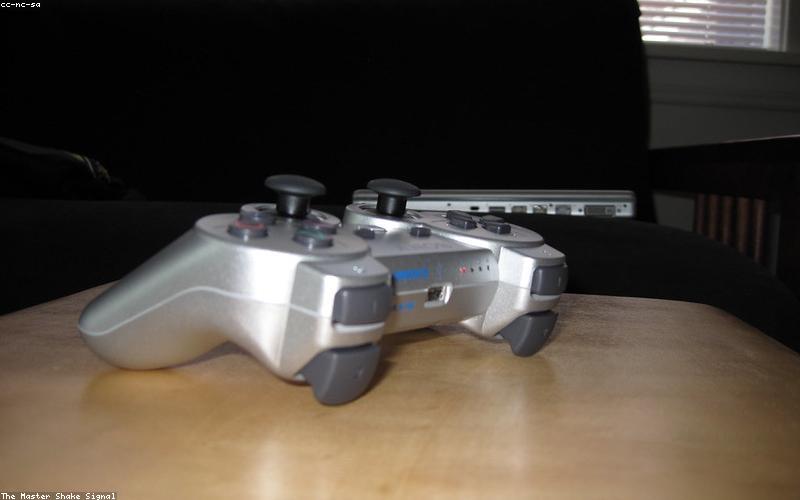
Sony quickly followed with the DualShock, which added two analog sticks and rumble feedback. Two sticks meant one for movement and one for camera control, which is now so universal that imagining a 3D game without it is almost impossible. The dual-stick layout shaped the design of every modern third-person and first-person game made for consoles. Without it, the entire mainstream shooter and action genre would look completely different.
Motion, Touch, and the Wii Detour
The Wii Remote in 2006 tried to throw out the entire controller paradigm. Point at the screen. Swing the remote like a tennis racket. The bet was that intuitive physical motion would attract people who found traditional controllers intimidating. It worked, for a while. Wii Sports made motion gaming a household phenomenon, and the Wii outsold the more powerful consoles of its generation.
The motion experiment also revealed limits. Most genres did not benefit from motion controls, and playtest fatigue from waving your arms for an hour became a real design constraint. The PlayStation Move and Microsoft Kinect tried similar approaches with diminishing success. Motion did not replace traditional input. It became a useful tool in specific situations, especially in VR, where the controller had to be your hands inside the simulated world.
Triggers, Touchpads, and Haptics
The PlayStation 5 DualSense controller pushed input precision in a direction most players did not see coming. Adaptive triggers that change resistance based on what is happening in the game. Haptic feedback that can simulate the texture of walking on different surfaces or the tension of a bowstring. The technology is genuinely impressive, and games like Returnal and Astro's Playroom show what is possible when designers build around the new capabilities.
The Xbox controller meanwhile has refined the traditional layout to something close to a benchmark. Steam and PC ports increasingly assume an Xbox-style controller as the default. Competitive players have driven a market for premium controllers with back paddles, swappable thumbsticks, and customized button layouts that cost as much as a console. The mainstream controller has become a serious piece of personal equipment.
What Comes Next
The next phase is already visible in pieces. VR controllers track full hand position and finger gestures. Meta and Valve are working on prototypes that read forearm muscle signals to detect intent before a button is pressed. Direct neural interfaces are moving from speculation toward early human trials. None of this means traditional controllers are going away. Keyboards survived the mouse, the mouse survived the touchscreen, and the gamepad will probably survive whatever comes next.
What does seem certain is that the controller will continue to be one of the most overlooked design surfaces in technology. The way an input device shapes what a game can be is still underappreciated outside the industry. Every time someone plays a great game, the controller in their hands is doing more design work than they realize. That has been true since the Atari joystick, and it will keep being true for whatever comes after the DualSense.
Test Your Knowledge!
Think you know this topic? Take a quiz and find out.
Nintendo History Quiz
From playing cards to the Switch, Nintendo has a fascinating history. How well do you know the company behind Mario?
PlayStation Exclusives Trivia
From Crash Bandicoot to God of War, how well do you know the games that defined PlayStation?
Related Articles

Nintendo vs. Sega: The Console War That Shaped Gaming
How the fierce rivalry between Nintendo and Sega in the early 1990s transformed the gaming industry and defined a generation.

The Lasting Influence of Classic Arcade Games
How quarter-eating cabinets from the late 1970s and 1980s established the design DNA of modern gaming.

The Gaming Handheld Comeback: Steam Deck, Switch, and Beyond
How the Steam Deck rebuilt the PC handheld category from scratch and reshaped what portable gaming could be — alongside the parallel Switch and ROG Ally moments.